Baby monitor radiation: what parents actually need to know
Few topics worry parents as quietly as this one. You put something in the nursery that transmits, and at two in the morning you wonder whether that was a good idea. The good news first: health authorities do not see a health risk from ordinary baby monitors. There are still a few simple things you can do to keep exposure as low as possible without giving up the monitor.
Germany's Federal Office for Radiation Protection (BfS) does not expect health effects from baby monitors because their transmission power is low. As a precaution it recommends placing the monitor as far from the crib as its function allows, plugging any power supply in far from the crib too, and choosing devices with low field strength. If you use a phone as a baby monitor, you can also switch on airplane mode and turn only WiFi back on.
What the authorities say
The German Federal Office for Radiation Protection (BfS) has looked at baby monitors several times. Its view fits in two sentences: given the low transmission power, no harmful health effects are expected. Because not every scientific question is fully settled, it recommends precaution anyway.
A common worry is that children might be more sensitive. On that, the BfS says there is no scientific evidence that children are more sensitive, and current studies tend to argue against it.
You may also have read that radio frequency fields are classified as "possibly carcinogenic". That is true: the International Agency for Research on Cancer put them in group 2B in 2011. Something lands in that group when a link cannot be ruled out but has not been shown either. The classification says nothing about how large a risk is, and it was based mainly on studies of phones held against the head during calls.
The BfS recommendations, turned into everyday steps
The BfS gives four concrete tips for baby monitors:
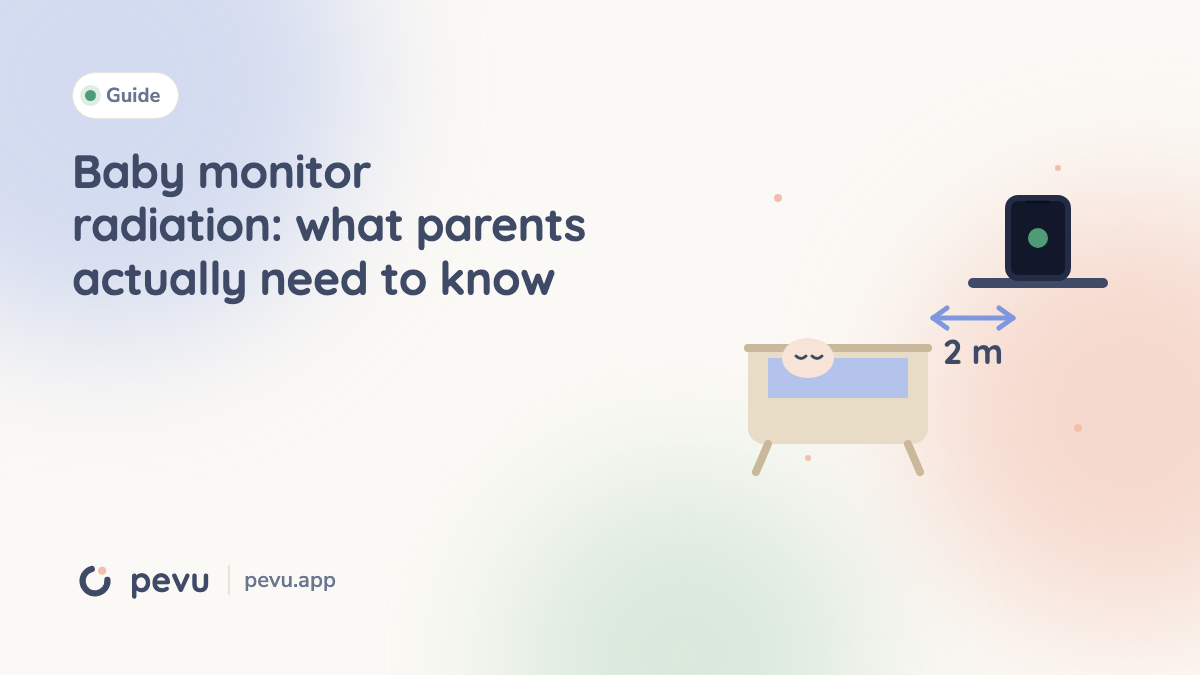
- Distance from the crib. Place the monitor as far from the child's bed as its function allows. The BfS does not give a fixed number. Many manufacturers state at least one meter (about three feet). On a dresser or shelf two meters away, a good microphone still hears every whimper.
- Power supply away from the crib. Power adapters create low frequency fields. Plug the charger into an outlet as far from the crib as possible. Battery powered devices do not create these fields.
- Low field strength. When buying, look for devices that transmit with as little power as possible.
- No constant range check. Some classic monitors keep checking by radio whether the parent unit is still in range. The BfS suggests avoiding that function and testing the range yourself once instead.
One point that has nothing to do with radiation matters even more: cords belong out of the child's reach. A charging cable hanging into the crib is a real hazard. Run cables behind furniture and put the device where small hands cannot get to it.
Classic monitor, camera monitor or phone: how each one transmits
| Device | How it transmits | What you can do |
|---|---|---|
| Classic audio monitor | its own radio link, often DECT | models with voice activation only transmit when there is sound |
| Camera monitor with its own screen | its own radio link with video, transmits constantly | distance, power supply away from the crib |
| WiFi camera with an app | transmits constantly to the WiFi, often to the internet too | distance, check whether a cloud is involved |
| Phone as baby monitor | WiFi, plus cellular unless it is switched off | airplane mode with WiFi, distance, charger away from the crib |
Keep in mind that a monitor that streams sound continuously transmits all night. That applies to apps too. Voice activation reduces transmission time, but it has a downside worth knowing: when nothing arrives, you cannot be sure whether it is quiet or whether the connection is gone.
Setting up a phone as a low emission baby monitor
A phone in the nursery can have two radio links: cellular and WiFi. A baby monitor on your own WiFi only needs one of them.
- Airplane mode on, WiFi back on. This switches off cellular completely. The phone then only transmits over WiFi. In the European Union, WiFi devices in the 2.4 GHz band may radiate at most 100 milliwatts. A phone on the cellular network may use considerably more.
- Sound instead of a constant picture. The less data flows, the shorter the WiFi transmits. Sound needs very little data, video a lot more. If you only want to listen at night, leave the camera off and take a quick look when you need to.
- Keep your distance. Shelf or dresser instead of the edge of the crib. One meter is the minimum, two meters is easy in most rooms.
- Charger far away. With a longer cable the phone can sit on the shelf while the adapter is in an outlet at the other end of the room. Make sure the cable is out of reach.
- Bluetooth off. The phone in the nursery does not need it.
By the way, your router transmits all the time, monitor or not. A baby monitor on your own WiFi adds only a small share in a home that already has a router.
How Pevu fits in
At home Pevu runs only on your own WiFi and needs neither cellular nor internet. You can put the nursery phone in airplane mode, turn WiFi back on and Pevu keeps working fully. The stream goes directly from device to device, not through a server.
At night Pevu sends sound only by default. The camera is really off, not just hidden. If you want to look, "Peek" turns the picture on for 30 seconds. Pevu deliberately streams sound continuously instead of using voice activation: that way the parent device can check every second that the connection is there and warn you if it drops. With Pevu, silence is always real silence.
Sound, the important alarms and talk back are free. Pevu is on the App Store for iPhone and iPad, and the Android app is coming to Google Play soon.
Frequently asked questions
Is baby monitor radiation dangerous? According to Germany's Federal Office for Radiation Protection, no harmful health effects are expected given the low transmission power of baby monitors. It still recommends precaution through distance and low emission devices.
How far should a baby monitor be from the crib? As far as its function allows. The BfS gives no fixed number, many manufacturers state at least one meter. Two meters on a shelf is easy in most nurseries.
Is a phone as a baby monitor worse than a regular monitor? Not necessarily. In airplane mode with WiFi on, a phone only transmits over WiFi, which in the EU is limited to 100 milliwatts in the 2.4 GHz band. Distance and a charger away from the crib help as with any other device.
Are baby monitors without WiFi lower in radiation? Not automatically. Classic monitors transmit too, many over DECT and some constantly. What matters is transmission power, transmission time and distance, not the type of link alone.
Can I put the nursery phone in airplane mode? With an app that works on your own WiFi, yes. Turn on airplane mode, then turn WiFi back on. Apps that run through a server also need internet over the WiFi.